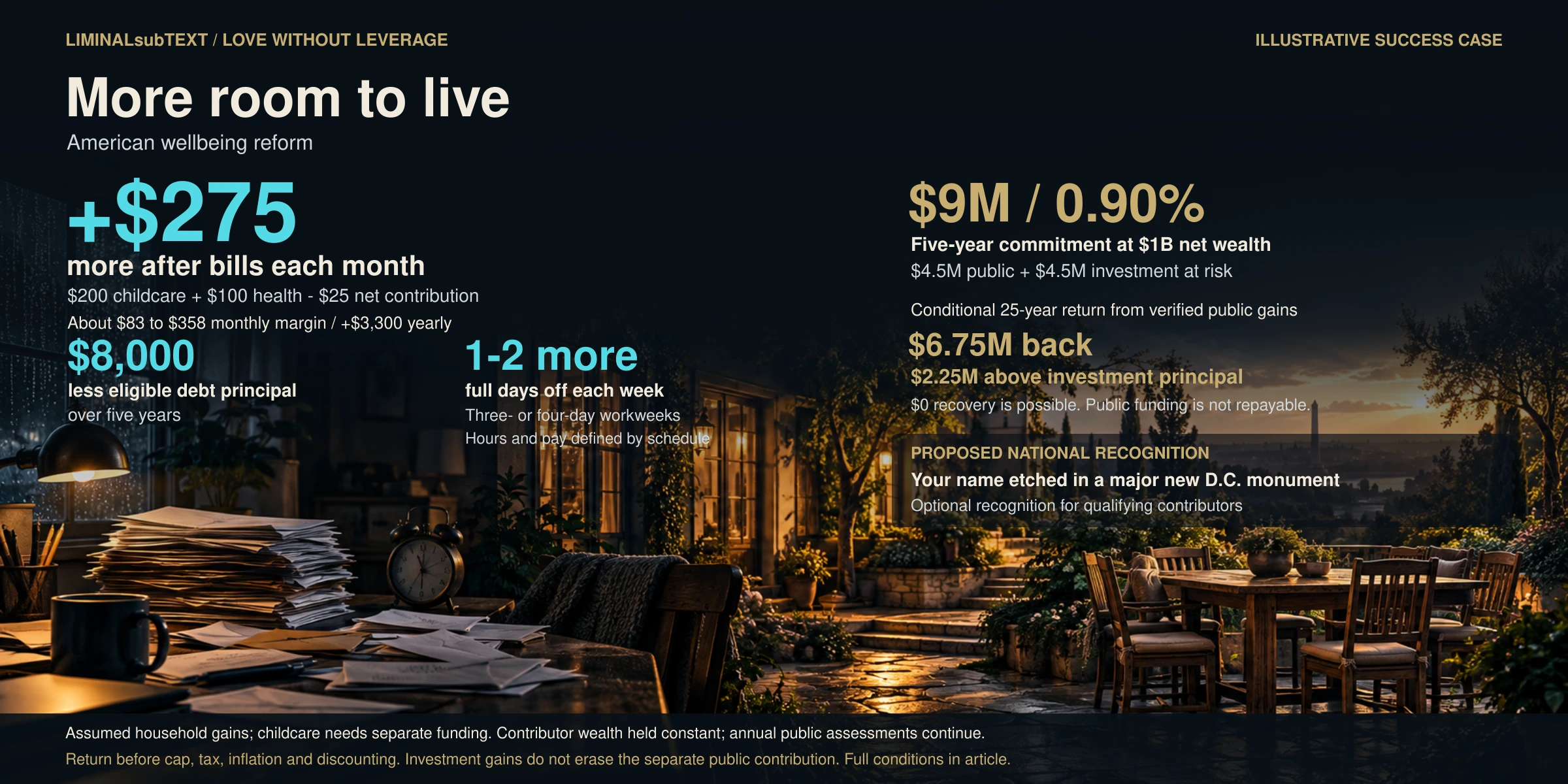
Success in this household illustration would mean $275 more after bills each month, alongside debt relief and work schedules that could create one or two additional full days at home.
This is one night's work on a country that could give people more room to live. Anyone who gives a damn can take it, sharpen it, and build it better.
What would change for the household
- Monthly relief. $200 less childcare and $100 less health costs, minus a $25 net purchase contribution after rebate, leaves $275 more after bills. That is $3,300 a year, moving the monthly margin from about $83 to about $358.
- Debt relief. $8,000 less eligible debt principal over five years in this illustration, counted separately from the monthly cash gain.
- Time at home. One to two additional full days off each week through three- or four-day schedules. The 40-hour household example uses four 10-hour days and gains one full day off. Three-day routes have their own hours and pay terms.
- The five-year difference. $16,500 more cash capacity plus $8,000 in debt principal relief creates a $24,500 better financial position relative to the same household without the program.
The family model assumes 2 adults plus 2.5 children, one paid childcare place, and $76,000 annual take-home income. These are planning assumptions, not national household averages or promised entitlements. Childcare savings require separately funded capacity.
A serious commitment from wealthy contributors
At $1 billion in net wealth, the illustrated commitment is $9 million over the first five years, or 0.90% of starting wealth if wealth stays constant. Half is $4.5 million in public funding. Half is $4.5 million in investment capital at risk.
The chance of a financial return
If independently verified public gains fund a payout of 1.5 times investment principal over the 25-year arrangement, this contributor could receive $6.75 million, including the principal. That is $2.25 million above the investment principal before any ceiling, tax, inflation, or discounting. Recovery could also be $0.
The public funding is not repayable, and annual public assessments continue after year five. Contributor figures exclude purchase contributions. A gain on the investment portion does not erase the separate public contribution.
Lasting American appreciation
The proposal could also include a major new national monument in Washington, D.C. Qualifying participating contributors could choose to have their names etched there, honoring their investment in America's renewal. Lasting recognition would sit alongside the opportunity to earn a return by helping build a more sustainable economy.
The expanded household comparison and simple overview follow, then the full theory and sources.
Expanded household comparison
National reference points
Income. Median household income was $87,460 before tax and $76,060 after tax in 2025. [28]
Spending. Average annual spending was $78,535 per consumer unit in 2024. [29]
Debt. Median debt was $88,100 among families with debt in 2025, including mortgages. [31]
Childcare. Full-day care ranged from $6,552 to $15,600 for one child in the 2022 county-price data. [30]
A family illustration
Two adults plus 2.5 children is our planning shorthand, not the measured national household size. This example assumes $90,000 gross income, $76,000 after tax, one paid childcare place, and $30,000 in eligible debt.
- Take-home income per month. $6,333 today; $6,333 if the model succeeds.
- Childcare per month. $1,000 today; $800 if the model succeeds.
- Health costs per month. $600 today; $500 if the model succeeds.
- Other bills and debt payments per month. $4,650 today; $4,650 if the model succeeds.
- New purchase contribution less rebate per month. $0 today; $25 if the model succeeds.
- Money left after bills per month. About $83 today; About $358 if the model succeeds.
- Work schedule per worker at 40 hours. Five 8-hour days today; Four 10-hour days if the model succeeds.
Over five years: $16,500 more cash capacity plus an illustrative $8,000 reduction in debt principal, a $24,500 better financial position than the same household without the program. More full days at home would also become possible.
What a wealthy contributor would put at risk
At $1 billion of net wealth, the illustrated assessments total $1.8 million a year in years one to five, or 0.18% of wealth annually. With unchanged wealth, five-year contributions are $9 million, or 0.90%; half, $4.5 million, is the investment portion eligible for conditional recovery.
If verified public gains support a payout of 1.5 times investment principal, this contributor could receive $6.75 million: $2.25 million above that investment principal before tax, inflation, discounting, or a ceiling. No qualifying gains can mean $0 repayment. The recurring contribution is not repayable.
The family budget and future awards are assumptions, not national averages or promised entitlements. Childcare savings require separately funded capacity and suitable scheduling. Contributor figures exclude the purchase contribution and ordinary wealth changes. Methods and longer-term comparisons follow.
An overview of the proposal
We want more time at home, steadier support, and fewer people left to handle a difficult stretch alone. Love Without Leverage means care that respects agency, with clear responsibilities for the institutions providing it.
Insurance and essential help. Coordinate existing coverage and fill defined gaps, including the costs and access needed to use care.
An account people can manage. Show credits, payments, and help in one place while preserving private banking, delegated administration, and human assistance.
A way to pay for it. Test rebated purchase contributions and high-wealth contributions above a threshold, with no ceiling on building wealth.
Five years of investment in people. Address practical barriers to stability and evaluate conditional investor recovery over 25 years.
More time at home. Offer workable three- or four-day schedules, with explicit pay terms, safe hours, childcare, and predictable time off.
More time for teachers. Reduce repetitive preparation, grading, and paperwork while retaining professional judgment and local teaching.
Education that follows the child. Support school, home, illness, disability, and language needs through a required baseline and useful continuity tools.
Freedom to study. Keep knowledge accessible and preserve private religious, cultural, and secular study without building belief profiles.
Children and families treated fairly. Teach boundaries, make help reachable, and keep concerns, findings, and coercive intervention distinct.
A useful next step at 18. Offer paid, voluntary civilian stewardship with portable skills and a reassessment every two years based on national, state, and community needs.
Adult thresholds with clear boundaries. Propose 21 for substances and explicit adult work; 18 for viewing pornography, adult consent, and enlistment. Enlistment would not lower substance ages.
Support for independent lives. Provide driving education and fair competence checks, protect adult workers, support equal marriage and safe homes, and define medical access.
Elections people can examine. Make counts and audits easier to follow while protecting ballot secrecy and keeping paper and in-person voting operational.
Keep what remains useful. Preserve practical skills, local histories, cultures, and usable offline processes alongside new technology.
Responsibility and public visibility. Keep personal records private while publishing spending, service gaps, institutional failures, corrections, and independently assessed results.
This is a developing theory. Published observations, illustrative arithmetic, proposed policies, and operating recommendations are identified where they appear.
What an American would receive and do
The proposal joins financial protection, education, work flexibility, and public service around one purpose: a dependable floor without a ceiling on personal achievement. It does not promise that hardship, crime, or poor decisions disappear. It aims to make recoverable setbacks less likely to become permanent exclusion.
What households would receive
Eligible households would receive insurance credits, purchase-tax rebates, and access to funded services. A wellbeing account would show what is due, what assistance applies, and where to ask for help. Private banking would continue separately. People could use a bank or other authorized administrator to manage permitted transactions without personally handling every calculation.
Parents would have access to educational materials and continuity when a child is sick or learning at home. Workers would have more access to compressed schedules where the job permits. Young adults could have a structured service and training route after high school. These are proposed benefits; exact awards and availability follow the funded terms of each program.
What people would be expected to do
Participants would provide accurate information needed for eligibility, keep required details current, meet agreed payment or program responsibilities, and correct known errors. Parents would ensure that children participate in the required educational baseline and assessments, with accommodations. A household could teach additional subjects, beliefs, and perspectives.
Additional investment assistance could carry duties relevant to its purpose, such as accurate reporting, agreed use of funds, or participation in chosen training. Community contribution would be encouraged and recognized, with compensation where appropriate. Essential care would remain independent of unrelated service, gratitude, ideology, and public disclosure of hardship. Caregiving, disability, illness, work schedules, and actual local opportunity would shape what is reasonable.
A usable system rather than another obligation
The operating design would include accessible apps, phone and in-person assistance, plain-language notices, delegated access, and an offline route. Optional reminders and a national information-alert feature could be switched off. Turning off optional alerts would not eliminate a legal notice or underlying responsibility; this proposal does not change separate emergency-alert rules.
The account would record specific services and unmet needs rather than a single moral score. Repeated financial difficulty would invite a confidential conversation about causes and practical help. A person could dispute an error, request a human decision, and decline optional coaching without that refusal becoming evidence of wrongdoing.
An illustrative funding model
These numbers are scenarios for discussion, not adopted tax rates or verified revenue estimates. The financing model starts with the cost of a defined protection package and works backward to contributions. The figures below preserve the earlier test case so the full proposal can be discussed consistently.
- 1% on covered final purchases. Plain meaning: $1 on a $100 purchase before rebates; Model duration: Recurring
- 0.10% on net wealth above $100 million. Plain meaning: $1 per $1,000 above the threshold; Model duration: Recurring
- Additional 0.10% on that excess wealth. Plain meaning: $1 more per $1,000 above the threshold; Model duration: Five years
The recurring illustration assumes $8 trillion in covered purchases and $20 trillion in assessable wealth after thresholds. That produces $80 billion plus $20 billion, or $100 billion annually, before collection losses and deferrals. The extra five-year assessment produces $20 billion annually, or $100 billion across five years under unchanged assumptions.
Where the recurring money would go
- Insurance support. 72%, or $72 billion annually in the illustration.
- Purchase contribution rebates. 20%, or $20 billion annually.
- Reserve. 5%, or $5 billion annually.
- Administration. 3%, or $3 billion annually.
Scenario only. These percentages divide the illustrative $100 billion annual budget; they do not measure national need or proven delivery costs.
The insurance allocation equals support for 40 million households averaging $150 a month. Awards would differ. Rebates are a separate $20 billion allowance. Administration at 3% is a placeholder, and the reserve is not an actuarial solvency finding.
Existing income and payroll taxes continue in this illustration. The purchase contribution would apply once to covered final consumption, excluding business inputs, insurance premiums, and direct medical care. No future economic gain is counted as cash available today. The expanded education, stewardship, and other reforms are not assumed financed by this $100 billion recurring illustration.
Who pays and who benefits first
The immediate benefit is lower net bills for households receiving more assistance than they contribute. Immediate costs fall on covered purchasers, people above the wealth threshold, and institutions adapting their systems. Long-term social gains are hypotheses, not compensation already received by those paying more.
- $45,000 income and $30,000 covered purchases. Annual insurance help and rebate: $2,400 plus $300; Annual new purchase tax: $300; Net monthly change: $200 better off
- $90,000 income and $50,000 covered purchases. Annual insurance help and rebate: $1,200 plus $200; Annual new purchase tax: $500; Net monthly change: $75 better off
- $250,000 income and $120,000 covered purchases. Annual insurance help and rebate: $0; Annual new purchase tax: $1,200; Net monthly change: $100 worse off
Illustrative awards, not an eligibility schedule. Net change covers only the new assistance and purchase tax; it excludes existing taxes, premiums, wealth assessments, and indirect economic effects.
Immediate burdens across the wider proposal
People receiving little assistance could pay more immediately. Small sellers would face collection and setup work. Insurers and banks would need secure interfaces and dispute procedures. Employers could face scheduling and staffing costs. Schools would face training and transition work even if repetitive labor later declines. Older teenagers would face new restrictions under the proposed age rules, and affected adult workers would need fair transition arrangements.
The proposal would seek to help financially strained households, students missing instruction, teachers carrying repetitive work home, young adults without a stable next step, and workers needing predictable time. A benefit in one part of life could be offset by a burden elsewhere; longer shifts, for example, may create childcare difficulties.
Protect against abrupt losses
Credits and rebates should begin alongside new contributions. Eligibility should taper rather than create sharp cliffs. Household size, available assets, existing assistance, coverage needs, and actual cash flow would inform support. Ordinary retirement savings and home equity need explicit treatment. High income with low wealth differs from high wealth with little liquid cash.
For a person with $1 billion of unchanged net wealth, $900 million is above the illustrative threshold. Each 0.10% assessment is $900,000 annually. In years one through five, the combined $1.8 million is 0.18% of total wealth. Only the investment portion has a possible recovery right; there is no guaranteed return.
Household budget for the opening comparison
The opening uses published national reference points to establish scale, then a separate family budget to explain the proposed changes. Census income, BLS spending, and Federal Reserve debt describe different populations and measures. The self-contained family budget below provides the comparison. [28, 29, 31]
Every amount in the following family budget is an illustrative assumption. Gross earnings are $90,000; $14,000 is allowed for income and payroll taxes, leaving $76,000 before household bills. This is not a tax calculation for a particular jurisdiction. Health premiums are included below rather than deducted from income a second time.
- Housing. $22,800 per year. Rent or equivalent housing outlay.
- Food. $12,000 per year. Groceries and other food.
- Transport. $8,400 per year. The assumed household transport budget.
- Childcare. $12,000 per year. One paid care place; other care assumed unpaid.
- Health costs. $7,200 per year. Household premiums and out-of-pocket costs.
- Utilities and connectivity. $4,200 per year. Utilities, internet, and phones.
- Other essentials. $2,400 per year. Clothing and other necessary outlays.
- Debt payments. $6,000 per year. Scheduled payments on existing debt.
- Total annual bills. $75,000 per year. Before the new contribution and assistance.
- Annual income left after bills. $1,000 per year. About $83 a month.
The model holds earnings and all other bills constant. It assumes $1,200 in annual insurance help, a $200 purchase rebate, and a 1% contribution on $50,000 in covered purchases, costing $500. That is $900 a year of net recurring assistance, matching the earlier $90,000-income household illustration. Covered purchases are an assumed subset of outlays, not the entire budget.
A separate success assumption reduces the $12,000 care bill by 20%, or $2,400 a year. This could require funded places, flexible scheduling, and provider agreements. A four-day workweek does not automatically reduce fixed childcare fees, and longer shifts can increase care needs. The additional care provision is not funded by the inherited $100 billion recurring illustration.
What success could change over time
Combining the $900 annual net assistance with the hypothetical $2,400 care saving produces $3,300 more annual cash capacity. Bills including the net new purchase contribution fall from $75,000 to $71,700, leaving $4,300 a year, or about $358 a month. This is capacity for saving, discretionary spending, or unexpected costs, not a prediction that every dollar stays in a bank account.
The five-year investment illustration adds an $8,000 eligible-debt principal award across that period. It uses the inherited direct-assistance average as an example rather than an entitlement. The award is counted as a debt reduction, not also as cash income or a second reduction in monthly debt payments. Interest, ordinary repayments, and any negotiated settlement affect the eventual balance separately.
- Net recurring assistance at $900 a year. Five years: $4,500; Twenty five years: $22,500
- Care saving at $2,400 a year for five years only. Five years: $12,000; Twenty five years: $12,000
- One illustrative eligible-debt award. Five years: $8,000; Twenty five years: $8,000
- Total cash capacity plus debt reduction. Five years: $24,500; Twenty five years: $42,500
This is static arithmetic in fixed illustrative dollars, not a forecast. The care saving stops after five years in the comparison; children are not assumed to remain in the same care setting for 25 years. Recurring eligibility and award amounts are held constant only to show the mechanism. No pay rise, investment return, inflation, medical saving, or wider economic gain is assumed.
Usable time as well as money
For a worker moving from five eight-hour days to four ten-hour days, paid weekly hours remain 40 while full days away from that job rise from two to three. At 48 working weeks, that is 48 additional full nonwork days, balanced by longer workdays. It is a redistribution of time, not 48 extra days' worth of leisure hours.
With an assumed one-hour round-trip commute, one fewer trip each working week also returns 48 hours a year per worker, or 96 hours if both adults make that change. Transport spending is held constant in the financial model so a possible commuting saving is not counted twice. Parents could align time together or stagger care. Rest, disability accommodations, workload, and suitable childcare determine whether those days are actually usable. [37]
Insurance assistance and independent banking
The wellbeing account would coordinate billing, credits, and approved payments across participating coverage. Health, auto, home or renters, disability, and life insurance would retain distinct contracts and claims processes. A single displayed balance would not make those policies one insurance product or promise universal subsidized coverage for all of them.
Protection matched to real needs
The essential package would consider premiums, deductibles, exclusions, liability limits, provider access, and out-of-pocket exposure. Someone without a vehicle would not need auto assistance. Medically necessary specialist care belongs in an appropriate health standard. Optional higher limits and enhanced services could be purchased separately.
Insurer pricing and public affordability credits would remain visible as separate entries. Existing employer contributions and public benefits would be accounted for before additional credits are applied, preventing duplicate reimbursement. Appropriate payment timing would avoid making a household advance the full bill and wait for relief.
Driving experience may inform auto risk, but health and auto underwriting are not interchangeable. Marketplace health premiums cannot be based on medical history or current health under the rules described by HealthCare.gov. [1] The plan would not use community participation or a wellbeing score to set health premiums.
More freedom across working arrangements
Portable assistance could reduce some dependence on full-time employment for affordable protection. It would not automatically replace employer coverage, Medicare, Medicaid, or other benefits. Coordination should preserve working arrangements and show who pays each portion. Premium help alone cannot guarantee affordable treatment or adequate provider supply.
Banks could act as authorized administrators for payments, notices, and account reconciliation. Delegation would be revocable and limited by purpose, amount, and duration where appropriate. A bank would not decide child safety, educational attainment, medical need, or social worth. People without a bank account would retain a practical access route; Direct Express is a precedent for dedicated benefit payments, not proof of this combined design. [5]
Keep errors contained
A disputed auto bill should not freeze a health credit. An inaccurate community record should not interrupt essential coverage. Participants would receive clear allocation rules for partial payments, notice of changes, and independent appeals. Public funds and participant balances would be legally separated from the operator's own money, with defined custody and failure procedures. The account label alone creates no deposit insurance or creditor protection.
Five years of practical wellbeing investment
The investment would address barriers that repeatedly destabilize a household: unmanageable eligible debt, housing insecurity, untreated needs, transport, childcare, or a lack of useful training. The intervention should follow the person's circumstances and actual local capacity. Referring someone to a service that does not exist is not successful assistance.
An investment alongside recurring protection
The five-year budget is separate from recurring insurance assistance and rebates. In the inherited static illustration, $100 billion is raised over five years. A possible allocation is $80 billion for direct assistance and $20 billion for services, delivery, and evaluation. Across 10 million households, the direct portion averages $8,000 over the full five years, with unequal awards according to need. This is not an adopted entitlement or a measured national requirement.
Debt assistance would identify the type of debt, verify ownership and terms, and distinguish negotiated settlement from paying face value. Housing, transport, and care support should be usable when needed. Education or training should connect to credible credentials and realistic work opportunities rather than attendance for its own sake.
Reciprocal responsibilities
A participant could agree to a manageable plan, accurate reporting, and the use of additional investment assistance for an agreed purpose. Suitable community participation could be offered as a voluntary route for learning and connection. Essential protection would not depend on unrelated civic work. Caregiving and disability accommodations must be meaningful; effort is different from obtaining an outcome beyond one's control.
The provider would have reciprocal duties: clear instructions, accessible services, timely decisions, and practical opportunities to meet the agreement. Unavailable jobs, unsuccessful treatment, or a family emergency would not establish misconduct. Essential insurance protection should remain dependable when someone struggles with an additional condition.
Recognition without ranking human worth
Services, deeds, teaching, and public contributions could be recognized through specific verified records. Public recognition would be optional and would not determine essential assistance, civic rights, or a person's moral worth. Participation records would serve a defined purpose and would not create a public social rank. Care should leave people more capable of directing their own lives.
Restrictions on discretionary assistance would require notice, context, accommodations, and an independent appeal. Recipients would not acquire an undisclosed personal debt or claim against future wages. Conditional investor repayment would come from an authorized share of verified public financial gains, not ownership of the people receiving help.
The twenty five year investment framework
The 25/5 structure means five years of investment within a 25-year evaluation and contractual horizon. It does not mean taking 25% of wealth. Contribution rates, thresholds, and any payment share are separate financial terms in the illustration.
Years one through five would collect and deploy investment funding. Qualifying results could be measured and paid during the 25-year horizon. The additional investment assessment would end after year five; recurring protection funding would remain separately governed. The commencement date would follow authorized launch, not the existence of a prototype.
Conditional recovery rather than a promised yield
The inherited test case assigns investors 20% of verified net public financial gains, subject to a contractual ceiling. This share is illustrative. The investment contribution is mandatory in that scenario while repayment is uncertain; a voluntary version would have different participation and funding economics.
- Verified cumulative net public gains $0. Illustrative 20% payment pool: $0; Comparison with $100 billion principal: No principal recovered
- Verified cumulative net public gains $250 billion. Illustrative 20% payment pool: $50 billion; Comparison with $100 billion principal: Half of nominal principal
- Verified cumulative net public gains $500 billion. Illustrative 20% payment pool: $100 billion; Comparison with $100 billion principal: Nominal principal recovered
- Verified cumulative net public gains $750 billion. Illustrative 20% payment pool: $150 billion; Comparison with $100 billion principal: Principal plus $50 billion before any ceiling
Arithmetic only, without discounting or a specified payout ceiling. Recovering nominal principal over many years does not establish an adequate real return.
Define gains before collecting money
A qualifying gain would be an attributable increase in public receipts or an actual reduction in public spending, after agreed costs without double subtraction. Ordinary economic growth, a household's premium relief, improved wellbeing, and projected savings are not automatically spendable public cash. Necessary care must never be withheld to manufacture savings.
Independent evaluation would compare outcomes with what likely would have happened otherwise, account for spillovers, and identify which government budget receives a gain. A saving in one agency does not authorize a payment from another. Contracts would specify payout caps, loss allocation, transfer, death, disputes, termination, and settlement at year 25.
Treasury's SIPPRA offers a component precedent for independently verified outcome payments. It does not establish authority or financial feasibility for this nationwide arrangement. [2] Improved lives remain valuable even when they produce no investor payment.
Contributor costs and conditional investment recovery
The financial illustration retains a recurring 0.10% contribution on net wealth above $100 million and an additional 0.10% investment assessment on the same excess for five years. These are proposed compulsory contributions in this scenario, not a voluntary subscription or guaranteed investment. There is no wealth ceiling. The rates, threshold, revenue base, and gain share remain illustrations.
- Net wealth $100 million. Annual public contribution: $0; Annual investment years one to five: $0; Annual total as share of wealth: 0%; Total across first five years: $0
- Net wealth $250 million. Annual public contribution: $150,000; Annual investment years one to five: $150,000; Annual total as share of wealth: 0.12%; Total across first five years: $1.5 million
- Net wealth $1 billion. Annual public contribution: $900,000; Annual investment years one to five: $900,000; Annual total as share of wealth: 0.18%; Total across first five years: $9 million
- Net wealth $10 billion. Annual public contribution: $9.9 million; Annual investment years one to five: $9.9 million; Annual total as share of wealth: 0.198%; Total across first five years: $99 million
Figures assume unchanged wealth and threshold, full payment, and no ordinary investment gains or losses. Purchase contributions are additional. The first-five-year total is 0.60%, 0.90%, and 0.99% of starting wealth in the three taxable examples. That describes assessed contributions, not a forecast of the person's eventual net worth.
At $1 billion, five-year contributions comprise $4.5 million of public funding and $4.5 million of investment principal. After year five, the annual public assessment continues at $900,000 under static assumptions. Over 25 years, assessments total $27 million, or 2.70% of initial wealth. A $6.75 million conditional payout would leave a net $20.25 million contribution, or 2.025%. Public contributions are not repayable; the investment gain is measured against investment principal.
How a successful public outcome could produce a return
Using the inherited $100 billion total investment and illustrative 20% share of independently verified net public gains, a $4.5 million contributor holds 0.0045% of the pro-rata payment pool. Payments could occur during the horizon as qualifying gains are verified; the comparison aggregates possible payments and does not specify their timing. [2]
- Verified net public gains $0. Individual payment: $0; Against $4.5 million principal: $4.5 million unrecovered
- Verified net public gains $250 billion. Individual payment: $2.25 million; Against $4.5 million principal: $2.25 million unrecovered
- Verified net public gains $500 billion. Individual payment: $4.5 million; Against $4.5 million principal: Nominal principal recovered
- Verified net public gains $750 billion. Individual payment: $6.75 million; Against $4.5 million principal: $2.25 million above principal
These figures are arithmetic before a contractual ceiling, tax, inflation, discounting, and financing costs. A nominal gain over many years is not an adequate annual return by itself. With no qualifying gains, the full investment principal can remain unrecovered. Contributors gain no authority over recipients, care decisions, education, or private records. The reward would follow attributable public financial improvement, not control over people.
Responsibility and counterbalances
The program would have one identifiable public authority accountable for delivery, with separate powers for funding, operations, evaluation, and adjudication. Accountability should remain visible when private banks, insurers, software firms, or community providers perform parts of the work.
- Funding and program rules. Responsible party in the proposed design: Authorized legislatures and public administrators; Counterbalance: Public budgets and judicial review
- Payments and delivery. Responsible party in the proposed design: Account operator and contracted providers; Counterbalance: Reconciliation, service standards, and audits
- Outcome evaluation. Responsible party in the proposed design: Independent qualified evaluators; Counterbalance: Published methods and external replication
- Complaints and corrections. Responsible party in the proposed design: Independent ombudsman and appeals bodies; Counterbalance: Deadlines, access to records, and enforceable remedies
- Privacy and security. Responsible party in the proposed design: Named accountable officers and vendors; Counterbalance: Independent testing and sanctions for misuse
- Education and child support. Responsible party in the proposed design: Qualified educators and relevant support agencies; Counterbalance: Family rights, professional standards, and review
Representation without institutional capture
Participants, caregivers, disability advocates, workers, teachers, providers, insurers, and contributors should have advisory representation. A large contribution would not buy control over eligibility, access to private records, or a veto over another person's care. Conflicts, recusals, procurement awards, and aggregate performance should be public.
An ombudsman would need resources and authority to obtain records, expedite corrections, investigate systemic problems, and seek suspension of harmful procedures. Staff and contractors would have protected reporting channels. Appeals should be accessible without paying an attorney merely to correct an administrative error.
Consequences for institutions as well as individuals
The system should record when a provider fails to deliver, an agency misses a deadline, or an algorithm generates wrongful denials. Contractor incentives should reward completed assistance and quality, with safeguards against excluding difficult cases. Public reporting must include failures, complaints, and corrective action.
Public money, participant funds, operating funds, and contingent investor rights would be separately accounted for. Contracts would define custody, permitted uses, reconciliation, insolvency treatment, and continuity. The institution operating an account should not also have unchecked power to deny assistance, determine wrongdoing, and judge its own appeal.
Privacy security and shared information
The wellbeing account would be a common interface over separate services. Private banking, medical records, education records, community activity, and judicial information would not be pooled into a universally browsable national dossier. Better coordination should mean sharing the answer needed for a task rather than exposing a person's whole life.
Exchange limited confirmations
An insurer could confirm the amount due and whether coverage is active. An eligibility service could confirm the authorized credit. A provider could confirm that an agreed service occurred. Each exchange would carry its purpose, authority, timestamp, and retention limit. The coordinating account would still contain sensitive information and require strong protection.
Optional sharing would be distinct from processing necessary for a specific benefit or legal duty. Permissions should be understandable, purpose-specific, and revocable for future optional access. Required audit records may still have retention duties. Participants should be able to inspect records, correct errors, and see significant access events.
Banks would receive payment instructions and necessary financial verification, not religious study choices, abuse disclosures, classroom histories, or unrestricted medical notes. No sale, advertising use, unrelated credit scoring, employer screening, or automatic cross-program punishment would be permitted under the proposed program rules.
Separation must work in practice
Separate systems can limit exposure only when credentials, permissions, encryption keys, and recovery processes are properly separated. A different network name does not make information safe. NIST's zero-trust approach treats access as something to verify rather than trusting network location. [7]
The security design would include strong authentication, safe recovery, limited delegated access, encryption, time-limited staff permissions, tamper-evident logs, supplier review, independent penetration tests, and vulnerability reporting. Bulk exports and major payment changes would require heightened controls. Backups and alternate payment routes would be tested.
Three levels of visibility
Individuals see their own information and relevant access history. Authorized staff see the minimum needed for their role. The public sees aggregate spending, methods, performance, and independent audits, with safeguards for small groups and re-identification. Transparency would concern institutional conduct, not a public ledger of household vulnerability.
Access, amendment, and health-privacy protections already exist in particular legal settings, but they do not cover every app or organization. The proposal therefore calls for dedicated protections rather than assuming existing laws cover the whole architecture. [3, 4]
Early support and dependable services
Financial or educational signals would identify a specific unanswered question, not establish a person's motives. Repeated missed payments might reflect illness, income loss, an administrative mistake, coercion, or a poorly designed service. The program should verify what it knows before acting on an interpretation.
An ordinary support sequence
For nonurgent financial concerns, the proposed sequence is to validate the record, send a private invitation, arrange a human conversation, and agree on practical assistance. Declining optional coaching would not itself reduce essential benefits. People could choose a suitable contact method and request another worker where feasible.
A financial signal alone would not authorize police dispatch or an uninvited home visit. Emergencies and suspected abuse have their own evidence, reporting, and response rules. Support staff need time, training, and authority; adding a nominal human approval to an automated decision is not enough.
The program would track false alarms, missed needs, unwanted contacts, referral completion, time to assistance, and disparities. It would measure whether services helped rather than counting messages sent. Inaccurate or incomplete eligibility information can cause wrongful denials, a problem documented by GAO. [6]
A limited connection with courts
Useful coordination could include participant-authorized hardship evidence for a payment plan, confirmation that legal aid or assistance is pending, and routing a particular court order. Courts and investigators would not gain general browsing access. Compulsory disclosure would require applicable authority, limited scope, recorded access, and notice where permitted.
Fraud allegations would follow an evidence-based process rather than arise automatically from help-seeking. A support worker would not become a general financial investigator. Poverty, disability, disagreement with officials, or an unsuccessful improvement plan would not become offenses.
Keep protection working during failure
An account takeover must not reveal private bank credentials. An outage must not force someone to re-prove eligibility from scratch. A disputed community record must not stop coverage. Operator failure, disasters, coercive household access, funding interruptions, and identity errors need defined response procedures.
The design would name who can stop a compromised process, authorize emergency payments, notify affected people, restore access, and provide remedies. Essential continuity needs both operating plans and funded capacity; it cannot rely on a promise that the system will never fail.
More time at home and with family
The workweek proposal begins with the life around the job. Parents could have more days with their children, couples could spend unhurried time together, and people could be home long enough to rest, see friends, or do something they enjoy. Three or four longer workdays would become an available option wherever the work can reasonably support it.
Employees could choose shorter shifts, additional work, or another workable arrangement. Doctors, service members, emergency personnel, and other occupations need appropriate exceptions and safety rules. Employers would be expected to develop feasible offerings with predictable schedules and meaningful employee choice.
- Three 10-hour days. 30 weekly work hours; 4 full days away from that job.
- Three 12-hour days. 36 weekly work hours; 4 full days away from that job.
- Four 10-hour days. 40 weekly work hours; 3 full days away from that job.
- Four 12-hour days. 48 weekly work hours; 3 full days away from that job.
What those days could make possible
Where parents' days off overlap during the school week, they could have a quiet morning, a meal together, time for intimacy, or simply a chance to rest before the children come home. Parents need time as partners as well as caregivers. A household could also stagger days off to cover more childcare, depending on its needs.
During summer and school breaks, more days away from work could mean more time with children: ordinary outings, shared meals, helping them learn, or being present without watching the clock. Single parents and other caregivers would also have more potential time at home, although a longer shift still requires reliable care on workdays. People without children would have the same opportunity to use their time as they choose.
Make the arrangement worthwhile
Four 10-hour days compresses 40 hours. Three 10-hour days reduces hours and requires an explicit pay arrangement. Four 12-hour days increases weekly hours and must not erase overtime. Current federal law generally requires overtime after 40 hours for covered nonexempt workers; additional rules and exemptions depend on the situation. [19]
Days off should remain free from routine work messages and unfinished assignments. Adequate notice, rest, accommodations, before-school and after-school care, and safe workloads would matter as much as the number of days scheduled. Time at home should be usable, rather than consumed entirely by recovering from an exhausting shift.
Portable healthcare help could reduce some pressure to choose working hours mainly for insurance eligibility. Its effect depends on the coverage funded. The prospect is more room for family and personal life, with pay and essential services sufficient to make that time affordable.
Education that follows the child
The education proposal would provide shared learning infrastructure while preserving state and regional curricula, local history, culture, and teacher judgment. Every child would have access to a limited required educational baseline, taken and assessed. School, home, illness, and family circumstances would change delivery, not erase the child's opportunity to learn.
A shared resource with local teaching
The earlier BALDR discussion described a free learning service with structured courses, AI-assisted instruction, completion records, and source-traceable materials. BALDR supplied the shared knowledge foundation. The current proposal develops that direction into practical educational continuity rather than making one technology the national school system.
Schools could select and adapt materials to their curriculum. Students would follow their actual coursework when absent or ill, avoiding a competing second course load. Families teaching at home could add instruction, beliefs, and perspectives above the required baseline. Participation and assessment would be required; ideological agreement would not.
Facts should remain distinguishable from interpretation. Uncertainty, theoretical answers, and multiple defensible explanations should be preserved rather than altered to serve a preferred cause. A student could question a lesson while demonstrating understanding. Local culture would enrich the material without converting a factual claim into whatever answer a profile prefers.
Project-funded learning materials would be licensed for free copying, printing, and adaptation, with downloadable offline versions. Existing copyrighted sources retain their rights. Schools would keep participation and safeguarding duties separate from the open knowledge foundation, which could be used without a wellbeing account.
Access creates reciprocal obligations
If participation is required, the program must make it practical through devices, connectivity or an offline equivalent, accessible materials, human help, and disability accommodations. Illness may require a reduced load, changed deadlines, or a pause rather than constant catch-up pressure. Families would receive clear expectations and a reachable educator.
Assessment would measure learning and guide support. A weak grade alone would not establish neglect or parental failure. Prolonged unexplained disengagement would prompt context-sensitive contact, with urgent safeguarding concerns handled separately. Completion data can indicate participation but cannot prove that a child is safe.
Accountability without watching the home
No continuous camera, microphone, or household surveillance is proposed. Required records would focus on participation, assessment, accommodations, and necessary follow-up. Children would have age-appropriate ways to ask a trusted adult for help. Parents would be able to correct records and understand consequential decisions. The required baseline concerns education, not conformity in family structure or religion.
Teacher support language access and personal study
Technology supports teachers. The initial proposal does not raise teacher pay; it seeks to remove a substantial share of repetitive labor so teachers can attend to learning, relationships, and students needing educational or social support. Pay remains a separate issue, not something workload relief declares solved.
Preparation tools could produce adaptable lesson materials, practice exercises, translations, and accessible versions. Routine grading and first-pass feedback could be assisted, with teacher review and override. Catch-up lessons would reuse the teacher's existing work. Administrative tools could organize records and draft routine communications for approval.
The design should return saved time to teachers rather than automatically enlarge classes, cut staff, or add reporting. Qualified educators would retain authority over instruction, consequential grades, accommodations, and referrals. Specialist support would remain available; teachers should not inherit every counseling or child-protection role. Human oversight is consistent with the Department of Education's AI recommendations. [20]
Language learning without losing the subject
An English learner could receive bilingual explanations, translated instructions, vocabulary support, and English practice while continuing to learn the subject. The platform would supplement qualified language instruction rather than substitute for it. Language proficiency should not be mistaken for subject ability. Federal guidance recognizes both English development and access to the standard curriculum. [21]
Guided personal study
A personal study period could offer coursework support, independent reading, cultural study, secular ethics, or privately chosen religious reading and reflection. Families could contribute context without a required religion field. Students' own conscience and the choice not to pray would be respected. Prayer accommodations should account for actual needs rather than assume one time suits every faith.
Public academic study about religion, private religious expression, and school-sponsored devotional instruction are distinct. The proposed model favors neutral access and private choice; using an app does not by itself resolve sponsorship questions. [22]
No religious profile would be required or inferred. Reading histories can reveal beliefs even without a label, so collection and retention would be minimized. Banks, insurers, and wellbeing scoring would receive no religious-study data. Secular options would be equally worthwhile, and optional belief-based context would remain distinguishable from the assessed factual curriculum.
Child protection with proportionate judgment
The aim is to give children knowledge, connection, and agency while treating families fairly. Children should understand body boundaries, consent, appropriate behavior, and how to ask for help. Parents should receive practical support and clear expectations without ordinary imperfection automatically becoming an allegation of abuse.
Separate concern from conclusion
A child's disclosure deserves a calm, serious response and accurate recording. A concern, a legally required report, a screened-in investigation, a finding, and removal from home are different stages with different standards. The platform would not turn every difficult interaction, missed assignment, disagreement, or low grade into an automated child-protection case.
A concern about a slap or spanking calls for contextual judgment, not a blanket exemption for physical discipline. A single incident can still be serious. Relevant considerations include the child's age and vulnerability, injury or risk, force, location, threats, pattern, coercion, and applicable law. The proposal does not endorse hitting or presume that the absence of repeated incidents proves safety.
Reporting duties can arise from reasonable suspicion rather than proof. Nothing in the support workflow would require a teacher to investigate first or delay a legally required report or urgent response. Definitions and reporting thresholds vary by jurisdiction. [23]
Protect families from unsupported conclusions
When there is no immediate danger and the circumstances permit, assistance, parent education, respite, disability support, and practical problem-solving should be available. Poverty, an unconventional household, religion, a child's disability, or parental disagreement would not by themselves establish neglect. Support decisions should distinguish inability to obtain necessities from deliberate refusal when resources are actually available.
Families would receive notice and an opportunity to correct factual errors and challenge decisions, subject to lawful safety-related limits. Coercive intervention would require its own legal basis and review. An unsubstantiated report is not automatically a knowingly false report; children and good-faith reporters must not be intimidated into silence.
Human responsibility at consequential stages
AI could assist with organizing information but would not independently decide abuse, credibility, removal, or parental guilt. Qualified people would assess context. Child-protection alerts would remain separate from ordinary financial outreach and optional app reminders. The evaluation would examine both missed harm and unnecessary intervention, including unequal treatment, so safety is not measured solely by the number of reports generated.
Proposed ages and the transition to adulthood
I propose an 18-21 period with more room to develop skills and judgment before certain consequential commitments. Age thresholds here are policy proposals, not a claim that every person matures on a fixed birthday. Legal adulthood, capacity, eligibility, and occupational rules remain distinct concepts.
- Alcohol cannabis and tobacco. 21 generally
- Adult sexual consent. 18 as the nonminor threshold
- Viewing pornography. 18 and older
- Work in explicit adult entertainment and sex work. 21 and older, including pornographic performance, stripping, and commercial sexual services
- Military enlistment. 18
- Combat deployment. 21, with a narrowly defined national-urgency override
- Gender-related medical decisions. Proposed adult threshold 18, with treatment-specific scope and access rules
- Driver licensing. Graduation-linked opportunity and demonstrated competence
Keep the categories separate
Enlistment would not lower the proposed age for alcohol, cannabis, or tobacco. The earlier military consumption exception is withdrawn from this theory so earlier substance access does not become a recruitment incentive. The proposed general threshold remains 21. Military duties and safety requirements remain separate from civilian permission; existing tobacco and Army cannabis rules illustrate that distinction. [9, 10]
Adult consent would not excuse coercion, incapacity, exploitation, or abuse of authority. Rules for close-in-age adolescent relationships require separate treatment so a nonminor threshold is not silently converted into a complete juvenile criminal code. Commercial performance also requires careful distinction from private expression and noncommercial images.
A gradual change rather than a sudden cliff
New age restrictions would need prospective dates and fair treatment of existing lawful arrangements, workers, contracts, and licenses. The 18–21 support pathway should make opportunity available rather than define all young adults as incapable. Stewardship, college, employment, parenting, disability, and other life paths would retain distinct accommodations and choices.
The proposal's purpose is more freedom with preparation and protection. Any restriction would therefore have to be assessed against its actual burden, benefit, and effect on the people whose choices it limits.
A stewardship pathway from eighteen to twenty one
Stewardship would offer a structured bridge after high school through education, service, practical training, competition, fitness, and career exploration. It would provide camaraderie and useful experience for young adults who do not want to commit immediately to college or the military. It should create a credible next step rather than label young people by their difficulties.
A civilian route with meaningful choices
The proposed operating model is paid, voluntary civilian participation with defined renewable terms and clear exit rights. Local and, where useful, residential options would accommodate different circumstances. Disability, parenting, transport, and health needs would shape participation. Participants should leave with credentials, references, experience, and relationships they can use outside the program.
Activities could include conservation, disaster preparation, infrastructure support, logistics, tutoring, community assistance, and supervised exposure to public-service careers. Workforce centers, community colleges, registered apprenticeships, and service organizations would connect learning to existing credentials. Registered apprenticeships already combine paid work, instruction, mentoring, and portable qualifications. [33] Supervision and fair employment rules would prevent the program from displacing ordinary paid workers.
Explore skills without surrendering agency
Participants and qualified staff could assess strengths and interests for civilian, public-safety, or military pathways. Individuals should be able to inspect and correct those records. Recommendations would not automatically assign a career, enlist a person, confer arrest powers, or create a permanent loyalty score. Public-safety exposure would not authorize unsupervised enforcement activity.
Clear standards would address safeguarding, harassment, hazing, discipline, complaints, and safe exit. Structure and connection may be valuable, but the program should not be presented as a guaranteed treatment for addiction or mental illness. Qualified care and recovery support remain separate needs.
AmeriCorps NCCC provides a component precedent for civilian team service with basic support, not proof that this larger proposed pathway is ready, funded, or interchangeable with it. [11]
Military service remains a separate commitment
I would retain enlistment at 18 but ordinarily defer combat deployment until 21. A national-urgency exception would need a defined trigger, accountable authorization, time limits, and oversight. Training, readiness, noncombat assignments, and exposure to danger are not identical categories. Stewardship participation would not silently convert into military liability.
The goal is the same period of exploration often associated with college, with a practical service route and genuine career growth. Participation should leave people with options they can use outside the program.
Stewardship reassessment every two years
Every two years, stewardship would undergo a calibratory reassessment of what service should teach and carry out. The review would respond to the needs of the nation, each state, and the communities actually receiving and delivering the work. Its purpose is to keep public service useful as circumstances change while preserving voluntary participation and portable capability.
- National. What the review would examine: Long-term resilience, major capacity gaps, and shared public needs; How it would affect service: Set broad priorities and support standards
- State. What the review would examine: Regional needs, qualified training capacity, credentials, and access; How it would affect service: Align pathways, funding, and professional requirements
- Community. What the review would examine: Local service gaps, participant experience, and provider capacity; How it would affect service: Choose suitable projects and improve delivery
Use evidence from the people doing and receiving the work
Participants, communities, educators, employers, disability representatives, service organizations, and qualified independent evaluators would contribute. The review would examine completed work, skills gained, safety, costs, retention, complaints, unsuccessful placements, and whether participants obtained useful options afterward. Participation counts alone would not establish success.
Training and placements could shift toward demonstrated needs, including care access, disaster preparation, conservation, practical repair, tutoring, logistics, and preservation of useful skills. The review would identify where existing apprenticeships, colleges, workforce centers, and service organizations can deliver the work more effectively than a parallel new institution. [11, 33]
Publish changes and protect existing commitments
Each cycle would publish what changed, why, what it costs, and how the revised approach affects participants and communities. Changes would normally apply prospectively. Existing commitments, compensation, earned credentials, and exit rights would be protected; new directions would not silently create military liability or a duty to serve indefinitely. Urgent needs between reviews would use separately accountable procedures rather than erase those terms.
Driving education and verified experience
The proposal would restore a common opportunity to learn to drive through school, with licensing connected to high-school graduation and successful demonstrated competence. Parents could also teach, subject to the same verified standards. Failing driving would not affect academic grades or prevent academic graduation.
A common opportunity and an independent test
The educational route would include road rules, hazard recognition, supervised practice, and an independently assessed practical standard. A parent-taught student would not bypass competence checks. Someone who fails would receive a route to more teaching and retesting rather than a permanent exclusion.
Graduation would be the expected opportunity to complete driving training, with an equivalent public route for homeschoolers, young people outside conventional schooling, and adults who did not graduate. Licensing would depend on demonstrated competence rather than possession of a diploma. Schools could share qualified instructors, accessible vehicles, and practice facilities while retaining independent tests and staged privileges.
A useful record with limits
Verified training and relevant driving experience could inform the insurance layer. A record should be accurate, contestable, proportionate, and limited in retention. A first failed test should not become a permanent penalty. Financial hardship, disability accommodations, or the prestige of a school should not be treated as driving risk without a valid basis.
Insurers would receive only relevant authorized driving information, not a student's full education or wellbeing history. Any use of grades or training measures would need validation for safety prediction and fair treatment. Records should support learning as well as underwriting.
Safer access without a guarantee
The intended benefit is a shared baseline of instruction and verification. Instruction alone does not prove crash reduction. NHTSA identifies graduated licensing as an evidence-supported approach and describes limits in evidence for prelicensure driver education alone. [12, 13] The design should therefore combine access to teaching with supervised experience and staged privileges where justified.
Vehicles, instructors, accessible adaptations, practice time, and retests would require funding. Rural transport and employment needs would matter when setting timing. The proposal should not make private family wealth the hidden condition for completing a supposedly universal opportunity.
Consent education and adult worker protection
I propose earlier, comprehensive, age-appropriate education about bodies, relationships, consent, and exploitation. The objective is informed judgment and protection, not pressure to become sexually active. The content would include both scientific knowledge and the personal dimensions of dignity, attachment, values, and wellbeing.
Education that develops with the child
Younger children would learn body boundaries, unwanted touch, trusted adults, and how to ask for help. Later instruction could cover puberty, reproduction, contraception, infections, emotional consequences, digital privacy, manipulation, and abusive relationships. Lessons should explain that consent is freely given and can be withdrawn, and that pressure or authority can undermine it.
No child should be required to disclose personal sexual experiences in class. Public teaching would respect differing beliefs without prescribing religion. Quality sexual-health education can support healthier decisions, including delaying activity; it does not require encouraging it. [14] Managing feelings privately must never mean accepting exploitation, involving minors in sexual content, or generating nonconsensual sexual depictions.
Legal adult work with enforceable protection
I propose legalizing adult sex work and setting 21 as the threshold for working in explicit adult entertainment or sex work, including pornographic performance, stripping, and commercial sexual services. Viewing pornography would have a separate threshold of 18. The intended protections particularly address risks faced by women while covering workers of every gender.
A worker should be able to refuse a client or act, withdraw consent, receive agreed pay, obtain confidential healthcare, report violence, and leave the industry. Payment does not purchase irrevocable consent. Safe working conditions, privacy, insurance access, employment classification, operator responsibility, and anti-trafficking enforcement would be part of the framework. New Zealand's law provides a concrete example of a statutory right to refuse despite a contract. [15]
The recommended operating approach would decriminalize consensual adult workers within the proposed 21+ framework while enforcing protections against coercion, violence, and exploitation and regulating commercial operators. Licensing should not create a public worker registry or fees that exclude vulnerable people from protection. The aim is reduced harm and stigma, not a claim that every transaction becomes safe when legal.
Child protection stands on its own
Access to adult sex is not an established remedy for attraction to children or a proven child-abuse prevention policy. The earlier hypothesis is not carried forward as a promised benefit. Clinical descriptions identify distinct attraction patterns and specialist treatment needs. [16] Pornography and AI are not substitutes for those services. Child safety requires education, reporting routes, prevention, investigation, and protection from retaliation regardless of the adult-work model.
Families equal rights and medical autonomy
The broader family objective is stable care, useful support, and personal agency. Work schedules, insurance assistance, education continuity, transport, and service opportunities should fit together so a parent is not expected to solve incompatible obligations alone. A missing childcare place would remain a visible service gap with an accountable follow-up, rather than become evidence of parental noncompliance.
Single mothers and family support
Single mothers should be able to reach the same dependable protection, educational continuity, childcare, transport, housing support, and training routes without having to become experts in separate bureaucracies. These shared services form the delivery foundation for a dedicated family-support approach; no separate award schedule is implied here.
Any later package should state what a parent receives, what is expected, and what happens when a job or care arrangement fails. A child's essential wellbeing should not depend on a parent's completion of unrelated civic activity. Family support would account for caregiving work and avoid penalizing a household simply for differing from a conventional model.
Marriage adoption and safe homes
I support same-sex marriage and quality adoptive homes offered by gay couples. The implementation principle is equal treatment through child-safety, stability, and caring standards, rather than treating orientation as evidence of parental fitness or unfitness.
Foster care, guardianship, and adoption are different arrangements. A child's legal status, interests, family connections, and appropriate reunification process should guide placement. Children temporarily in care are not all available for adoption. Marriage rights would not depend on agreeing to adopt.
Gender-related medical decisions
I propose 18 as the threshold for independent adult gender-related medical decisions, access to qualified providers, and freedom from political loyalty tests for doctors. This is a policy direction, not a clinical conclusion about every intervention. Rules governing care for minors must distinguish specific treatments from counseling and ordinary healthcare.
Social transition, counseling, puberty-related medication, hormones, and surgery are distinct. An eventual rule must specify its scope. Clinical suitability, informed consent, alternatives, capacity, and risks require qualified assessment. Practitioners should not have to act outside their competence or take a political loyalty test to provide appropriate care.
The intended balance is meaningful patient access with professional duties and conscience rules precisely defined. State flexibility would concern delivery while respecting the access standard established for the program. Qualified assessment and a timely alternative referral route would make access practical, while clinicians retain responsibility for competence, clinical suitability, and informed consent.
Civic responsibility justice and integration
The proposal would retain proportionate consequences for actual wrongdoing while making help and recovery more accessible. Offense-specific sanctions would identify the harm, evidence standard, victim support, and route to appeal. Poverty, lawful disagreement, a failed wellbeing plan, or inability to obtain a service would not become misconduct.
Proportionate justice and useful civic work
Any new penalty should identify the harm, evidence required, proportional sanction, victim support, and appeal. Greater severity should not be advertised as a guaranteed reduction in crime. NIJ's deterrence summary emphasizes the importance of certainty of detection relative to simply increasing severity. [18]
I also propose paid jury opportunities for older adults with strong community contributions, reducing disruption to teachers and other essential workers. The compensation and civic-participation goals are preserved. Selecting a trial pool by government judgments of social merit, however, conflicts with the representative-selection approach described by federal courts. [17]
The recommended route is better juror pay, transport and caregiving support, scheduling, and hardship procedures while retaining representative selection and impartiality. Older adults could also hold paid court-support, accessibility, mentoring, or community-service roles. Those jobs must not purchase influence over verdicts.
One direction with distinct responsibilities
An integrated charter would establish dignity, freedom, opportunity, accountability, and independently measured results. Each program would still have its own authority, budget, operator, and data boundaries. Election functions would remain separate from benefits, private banking, and educational records. A bank could administer payments without seeing classroom disclosures. Stewardship assessment would not determine family benefit eligibility. A driving record would not become a general citizenship score.
The expected connections are practical: affordable protection may support work flexibility; continuity tools may reduce teacher labor; predictable schedules may help families; stewardship may broaden opportunity. These are integration hypotheses, not additive benefits that can be counted twice or assumed to finance one another.
A gradual and adjustable transition
Implementation would proceed through authorized, funded demonstrations and explicit legislative decisions, preserving existing lawful arrangements during defined transitions. National contributions, age rules, and compulsory duties cannot be created by a software pilot. Programs could advance in stages without making every benefit depend on every disputed provision passing at once.
Implementation would remain gradual and adjustable. Public knowledge, service information, and assistance with navigation can be useful while broader reforms are evaluated. The 25-year horizon describes the proposed investment arrangement, not a prediction of how long political adoption will take.
Voting with public verification and private ballots
I propose using part of the platform for voting and public decision-making, with clearer local counts and an optional way for people to state where they voted. The objective is easier participation and evidence people can examine when they question a result, without making everyone reveal their choices. This chapter preserves that direction while distinguishing a public information service from the more demanding task of securely casting a binding ballot.
Layers that people can understand
- Public results. What a person could see or do: View totals by contest and appropriate district or precinct, source records, revisions, and audits; Privacy boundary: No link from a person to a marked ballot
- Private voter service. What a person could see or do: Check authorized registration information and ballot receipt or acceptance status; Privacy boundary: Identity data restricted to the necessary election function
- Independent verification. What a person could see or do: Examine reconciliation, audit evidence, and any validated cryptographic proofs; Privacy boundary: Verification must preserve ballot secrecy
- Optional public expression. What a person could see or do: State a preference or self-report a vote if desired; Privacy boundary: A personal statement is not an official receipt or proof of the count
Explain the count and its changes
The dashboard would identify the election authority, contest, geographic boundaries, reporting time, and whether a result is unofficial or certified. It would show understandable updates and corrections, with links to source records and explanations of outstanding categories of ballots. Publication would follow lawful timing and protect small groups from being identified through overly detailed results.
EAC describes canvassing as reconciling ballots and voters so valid votes are included, with results remaining unofficial until certification. [25] A changing total would not by itself establish tampering. A useful platform would let people trace the change and submit a documented concern to the responsible authority.
Keep participation separate from wellbeing administration
Election authorities would retain election responsibilities. A wellbeing operator or bank would not determine voting eligibility, see ballot choices, or condition assistance on voting, abstaining, or supporting a position. People could use election services without a bank or wellbeing account. Civic consultations and nonbinding polls would be clearly labeled and would never be presented as certified elections.
Public self-reports could support discussion but would be incomplete and unverifiable as a population count. They could not substitute for the official canvass, independent audits, or an evidence-based challenge process. The goal is to let people examine the process without requiring them to expose their ballot.
Ballot secrecy and preservation of working processes
Public results would not use partial Social Security numbers or reusable private usernames as ballot identifiers. Four SSN digits are neither unique nor a safe anonymity mechanism. A reusable username can be linked to other activity; hiding a legal name does not necessarily hide the person. Election-specific verification should protect inclusion without exposing selections.
Verify inclusion without creating a coercion tool
A privately delivered, election-specific verification mechanism may be worth investigating, provided it does not disclose selections or let someone prove those selections to a buyer, employer, partner, or other person exerting pressure. A receipt that proves how someone voted can undermine the freedom of a secret ballot even when disclosure is described as optional.
The preferred design would permit personal political expression while avoiding an official identity-to-choice lookup or shareable proof of a marked ballot. Any cryptographic verification would need independent examination of secrecy, coercion resistance, accessibility, device compromise, and the entire election process. A random identifier or an encrypted database alone would not establish those properties.
Remote ballot casting through the platform remains a theoretical proposal, not a declared secure capability. The National Academies' 2018 review warned against Internet ballot return without robust secrecy, security, and verifiability guarantees. [26] That warning motivates testing rather than serving as a claim that an app has solved the problem. Public results and voter assistance can be developed separately from remote casting.
Keep paper and in-person voting operational
Polling places, accessible in-person voting, voter-verifiable paper records, custody procedures, recounts, and independent audits would remain working parts of the design. EAC's 2025 policy supports paper-based, auditable, software-independent systems. [27] A paper trail should support routine verification, not exist only after a computer failure.
Fallbacks would be funded, staffed, practiced, and reconciled with digital records. A switch during an outage must not lose valid ballots or allow duplicate votes; procedures would specify authoritative records, eligibility checks, provisional handling, and lawful recovery. A paper backup by itself does not cure a compromised remote ballot.
Preserve knowledge as well as equipment
This principle would apply across the reform: retain usable offline services, practical skills, records, and accessible human assistance when technology is introduced. Preserve local histories, cultures, languages, and descriptions of older processes, including why they existed and what they taught us. Historical preservation need not require continued use of a harmful or unlawful practice. New tools should expand capability while leaving people able to function, learn, and participate when those tools are unavailable.
Connected services with private personal records
The proposal would make existing services easier to use together while retaining identifiable institutions responsible for decisions. A shared service directory, permitted eligibility confirmations, appointment routing, status updates, accessible notices, and complaint handling could reduce repeated administration. Shared budgets and unrestricted record access would not be presumed.
A maintained map of help people can actually reach
Open Referral's Human Services Data Specification already provides an exchange format for information about services, organizations, and locations. [32] Participating providers could publish verified eligibility information, access methods, costs, opening hours, accessibility, and update dates. Availability and waiting-list information would require maintained provider agreements. A directory entry would not be treated as proof that a place or appointment exists.
Libraries, community-action agencies, workforce centers, schools, health centers, and suitable community organizations could offer coordinated local access with funded staff and private spaces. Head Start and community-school models provide relevant examples of connected support, while health-center sliding fees and registered apprenticeships supply other useful components. [33-36, 39-40] Existing eligibility, capacity, and funding terms still govern each program.
One household change without retelling an entire life
Imagine a parent whose working hours change. The parent reports the change through a private service interface or local help desk. Only relevant programs receive the permitted information needed to reassess support. A coordinator helps align childcare, transport, and training options, with the parent choosing which offers to pursue.
If there is no suitable childcare place, that unmet need stays visible and assigned for follow-up. The public can see the capacity shortage and the institution's response through privacy-protected reporting. The family retains its privacy, and the parent's inability to obtain an unavailable service remains a delivery problem the system must help resolve.
A person could seek help without a bank account, inspect and correct records, change an authorized administrator, and decline optional coaching. Banks would receive necessary financial instructions rather than clinical notes, abuse disclosures, religious reading, or classroom histories. A failed login, vendor failure, or disputed record would have a funded continuity route.
Visible results and an adjustable transition
The program would publish authorized funding, cash collected, commitments, spending, reserves, and independently assessed results. Reporting would also show waiting times, unresolved referrals, erroneous denials, appeals, unwanted contacts, service failures, and corrections. Appropriate aggregation and suppression would protect small groups and prevent household vulnerability from becoming public data.
Measure whether life becomes more manageable
Evaluation would follow coverage continuity, household stability, usable time off, learning, teacher workload, service access, safety, and participant agency. Comparison methods would distinguish an attributable program effect from ordinary economic growth or changes that would have happened anyway. Humane gains would be reported even when they create no payable public financial saving.
The proposed quarter-century national Trends Index could show the wider context. Program evaluation would separately test what these interventions caused. A national trend by itself would not establish that this proposal produced it. Measures would use necessary administrative information and proportionate voluntary research rather than continuous household observation.
Improve delivery before assuming an efficiency saving
GAO's work identifies actual opportunities to address fragmented services and shared administrative functions. [38] Those findings could guide a worklist for cooperation, procurement, and evaluation. They do not turn historical savings or projected reductions into cash available for this program. Better access may reveal unmet demand and require additional staff, places, and treatment capacity.
Later demonstrations would have an authorized, funded scope, participant protections, independent evaluation, and explicit expansion decisions. Unsafe procedures could be suspended while essential assistance continues through alternate routes. New technology would be introduced alongside practiced human, paper, and offline processes, preserving the ability to function when a tool fails.
Reference register for the financial foundation
The references support particular observations and component precedents. They do not validate the combined budget or establish that the reform will produce its intended outcomes. Numbered references identify the evidence used; household and contributor arithmetic remains illustrative.
[1] HealthCare.gov — How insurance companies set health premiums
Marketplace pricing factors and limits on health-status pricing. Read source
[2] US Treasury — SIPPRA frequently asked questions
A component precedent for independently verified outcome payments. Read source
[3] US Department of Justice — Privacy Act of 1974
Federal records protections and access framework; not universal app coverage. Read source
[4] HHS — HIPAA and online tracking guidance
Health privacy obligations depend on covered entities, associates, data, and context. Read source
[5] US Treasury — Direct Express
Dedicated benefit-payment access as a component precedent. Read source
[6] GAO — Eligibility data report retained from the financial plan
Data accuracy and completeness can affect eligibility decisions. Read source
[7] NIST — Zero Trust Architecture
Security should not assume trust merely from network location. Read source
[8] US Supreme Court — Moore v United States opinion
The holding does not decide taxation of wealth holdings or net worth; relevant to financing authority. Read source
[19] US Department of Labor — Overtime Pay
General federal overtime rule for covered nonexempt employees. Read source
Financial rates, assumed contribution bases, household awards, participation counts, and returns are illustrations. Published household benchmarks retain their dates and populations. Version 0.3 adds the family comparison, conditional contributor example, two-year stewardship reassessment, and connected-service approach.
[25] EAC — Election results canvass and certification
Official reconciliation, updates, and certification status. Read source
[26] National Academies — Securing the Vote 2018
Internet ballot return and the need for robust secrecy, security, and verifiability. Read source
[27] EAC — Paper based and auditable voting systems 2025
Paper records, software independence, and accessible private voting. Read source
Reference register for education and social policy
[9] FDA — Tobacco 21
Federal sales age and absence of a military exemption. Read source
[10] US Army — Cannabinoids and readiness May 2026
Army restrictions are separate from state cannabis permission. Read source
[11] AmeriCorps — NCCC program overview
Civilian team service as a component precedent. Read source
[12] NHTSA — Graduated driver licensing
Evidence for staged novice driving privileges. Read source
[13] NHTSA — Prelicensure driver education
Limits of education-only crash-prevention claims. Read source
[14] CDC — Sexual health education
Skills, relationships, and healthier decisions. Read source
[15] New Zealand — Prostitution Reform Act section 17
Statutory refusal rights despite a commercial contract. Read source
[16] MSD Manual Professional — Pedophilic disorder
Clinical description and specialist treatment context. Read source
[17] US District Court Northern California — Juror selection
Random selection from a fair cross-section of the community. Read source
[18] National Institute of Justice — Five things about deterrence
Distinguishes detection certainty from sentence severity. Read source
[20] Department of Education — AI and the future of teaching and learning
Human oversight in educational AI. Read source
[21] Department of Education — English learner fact sheet
English development and equal participation in the curriculum. Read source
[22] Department of Education — Religious expression guidance February 2026
Current guidance landing material; full implementation requires review of the operative text and relevant case law. Read source
[23] Child Welfare Information Gateway — Definitions and reporting
Definitions and reporting thresholds vary; state examples include Florida, Missouri, and Texas. Read source
[24] US Code — Education curriculum limits section 7906a
Federal restrictions relevant to the education baseline. Read source
References for household and service models
[28] US Census Bureau Income in the United States 2025 Published September 15 2026. Median household money income $87,460 and post-tax income $76,060 are separate national measures. Read source
[29] Bureau of Labor Statistics Consumer expenditures in 2024 Mean expenditure $78,535 per consumer unit. The average unit had 2.4 people; this is not a budget for the 2 plus 2.5 family illustration. Read source
[30] US Department of Labor National Database of Childcare Prices 2022 county data, discussed November 19 2024. Full-day price range $6,552 to $15,600 for one child depends on age, setting, and location. Read source
[31] Federal Reserve Changes in US Family Finances from 2022 to 2025 October 2026 report, table 4, printed page 25. Median debt $88,100 among debt-holding families; the measure includes mortgages. Read source
[32] Open Referral Human Services Data Specification A format for exchanging service, organization, and location information rather than a universal personal record. Read source
[33] US Department of Labor Registered Apprenticeship Program Paid work, mentoring, instruction, and portable recognized credentials as component building blocks. Read source
[34] HRSA Health Center Program Sliding Fee Discount Program Ability-to-pay protections and discounts within a health center's approved services. Read source
References for local support and public accountability
[35] ACF Community Services Block Grant Community-action infrastructure and relevant local services. Read source
[36] Department of Education Full Service Community Schools An existing model for school and community-service connections. Read source
[37] NIOSH Center for Work and Fatigue Research Health and safety risks associated with nonstandard schedules and extended hours. Read source
[38] GAO 2026 Annual Report on Duplication Overlap and Fragmentation A source of documented efficiency opportunities, not a funding appropriation for this proposal. Read source
[39] ACF Head Start Services Early-learning, health, and family-support components. Read source
[40] IMLS Public Libraries and Workforce Development Research on libraries' role in workforce and small-business support. Read source
An invitation to improve this work
This is one night's work. I brought together the pieces I could see and tried to make them serve people better. Anyone who actually gives a damn can take this, check it, sharpen it, and build it better. Keep the evidence visible, preserve people's freedom, and change what does not hold up.
I don't own improving livelihoods. That's an inherent duty of being a human.